You Don't Need to Be Perfect to Help Someone
You don't need to be an expert to help someone. Your imperfect experience, shared honestly, can be exactly what someone a few steps behind you needs.

Last Tuesday, a colleague asked me for advice on managing a difficult team conversation. I almost deflected. My internal monologue went something like: My own team meetings are messy half the time 😅. Who am I to tell anyone how to do this?
I gave her what I had anyway. Two practical tips, one caution about what not to say, and a reminder to listen before reacting. She came back the next day and told me it worked. Not perfectly, but enough to shift the dynamic.
That small moment cracked open a belief I've carried for years: that you need to be an expert before your insight counts. How to help others without being perfect starts with accepting that your value isn't measured by your mastery. It's measured by the gap between you and the person you're helping 🤝.
The Trap of Waiting Until You're Good Enough
For most of my life, I believed I had no business sharing advice because I wasn't the best at anything. Not the top performer at work. Not the fittest person at the gym. Not the most disciplined meditator. Not the most articulate writer ✍️. I looked at people who taught, coached, and mentored and assumed they had earned that right through some threshold of excellence I hadn't crossed.
The question I kept asking myself was: Who am I to teach anyone when I'm still figuring things out myself?
That question sounds humble, but it's actually a trap 🪤. It keeps you silent. It keeps your hard-won lessons locked inside your head. And it denies people who are a few steps behind you the chance to learn from your stumbles.
You Don't Need to Be the Guru
Here's the shift that changed things for me.
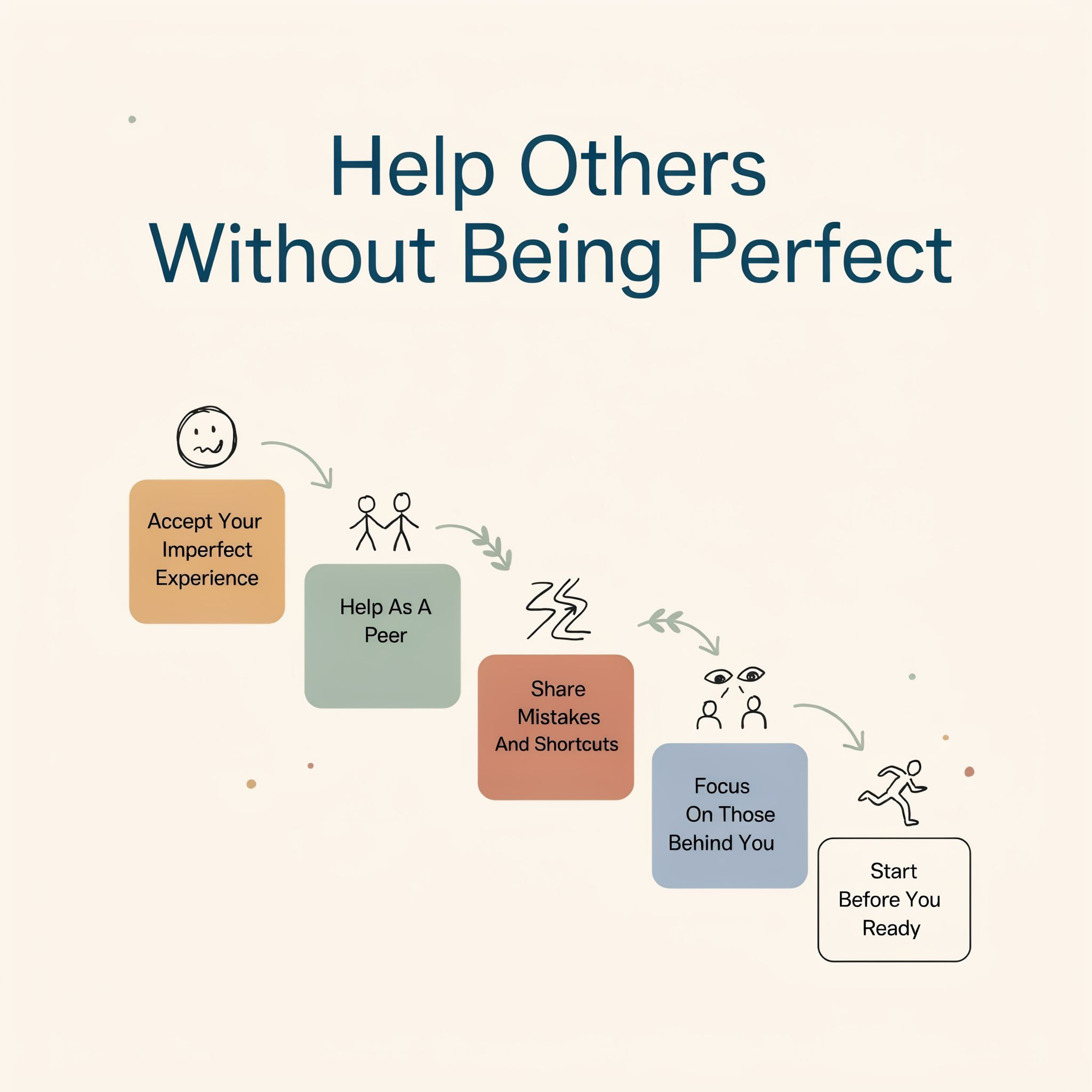
I don't have to help people from the position of an all-knowing expert. I can help from the position of a slightly more experienced peer 🧑🤝🧑. Someone who's walked the path a little further, tripped on a few of the same roots, and can point out where they are.
Think about it this way. If you're two years into learning a craft, a language, a business, or a relationship pattern, there's someone who's at month three. They don't need a grandmaster. They need someone who remembers what month three felt like and can say, Hey, watch out for that thing right there. I hit it too 🚧.
That's not a lesser form of teaching. That's actually the most relatable kind. The guru is so far ahead that their advice can feel abstract and untouchable. The peer who's a few steps ahead feels immediate, grounded, and practical.
What You Actually Have to Offer
You don't need a complete blueprint for success to be useful. You need a piece of the map with better labels 🗺️.
What you can share:
- Mistakes to avoid, the ones that cost you time, energy, or confidence
- Shortcuts that worked, even small ones that saved you twenty minutes or one unnecessary argument
- People worth following, the voices and examples that helped you most
- Encouragement, sometimes the most valuable thing you can offer is keep going, this part gets easier
None of that requires perfection. It requires honesty and a willingness to speak from where you actually stand 📍.

Adopt This Mindset Wherever You Are
This isn't just about writing or teaching. It applies everywhere:
- In your business, where you hesitate to share a strategy because you haven't scaled to seven figures yet
- In community meetups, where you hold back from offering perspective because someone else seems more knowledgeable
- At work, where you stay quiet in meetings because your idea isn't fully polished
- In friendships, where you don't share what you've learned about communication because your own relationships aren't flawless
In every one of these spaces, someone less experienced than you is struggling with something you already navigated. Your insight, even if it feels basic to you, might be exactly what they need to hear right now 💡.
The Criticism You'll Face and Why It Doesn't Matter
Some people will think your advice is too basic. Some might call it obvious or even unhelpful. They have the right to their opinion, and honestly, they might be right for their own situation 🤷.
That doesn't change what you're doing. You're not trying to be the definitive voice on anything. You're offering what you have, from a place of good intention, to whoever finds it useful.
The people who are ahead of you will skim past. The people at your level will nod along. The people behind you will thank you. Focus on the last group 🎯.
Start Before You Feel Ready
Here's what I want you to take from this: you don't have to be perfect to start contributing 🌱.
Share the tip. Write the post. Answer the question. Offer the perspective. Do it imperfectly, with the full honesty that you're still learning too.
You'll find that the act of sharing sharpens your own understanding. And somewhere along the way, the happiness that comes from being useful, from knowing you helped someone save a little time or avoid a little pain, that happiness finds you.
Not because you became an expert. Because you decided your imperfect experience was worth sharing.
And it is.
Questions readers ask
- How can I help others if I'm not an expert?
- You can help others by sharing from your position as a slightly more experienced peer. You don't need complete mastery—just honesty about what you've learned, including mistakes to avoid, shortcuts that worked, and encouragement to keep going. People a few steps behind you benefit most from relatable, practical insights rather than abstract expert advice.
- Do you need to be perfect to give advice?
- No. Your value in helping others isn't measured by your perfection but by the gap between your experience and theirs. Sharing your stumbles, lessons, and imperfect experiences can be exactly what someone struggling with the same challenges needs to hear.
Join the conversation
What did this bring up for you? Share a moderated reflection with the Entourage Life community.